The First Hour Wins the Night: Dance-Floor Lessons From 200 UK Weddings
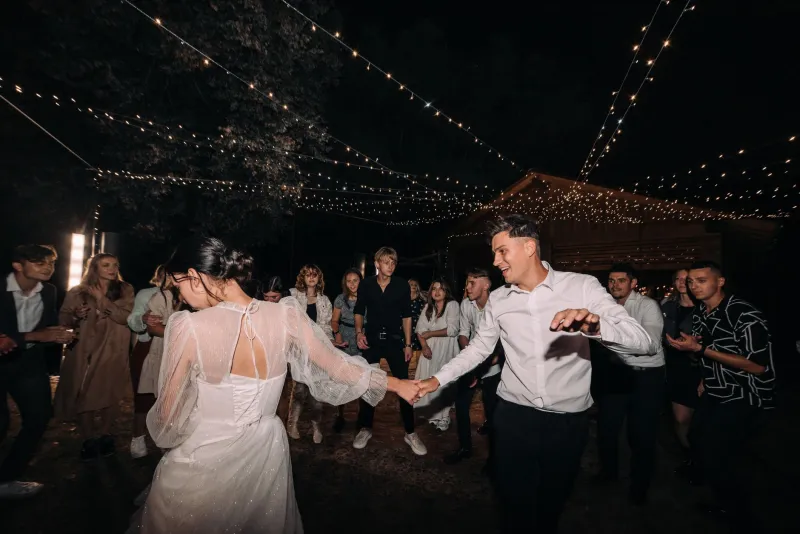
I started keeping notes on dance floors out of pure nosiness. Someone would press play, four people would drift towards the bar, and I'd wonder why. Two hundred or so UK weddings later — village halls, marquees, hotels with a sound limiter and a grumpy night porter — the reasons are less mysterious than couples think. They're just rarely written down.
So this is the notebook, tidied up. No theories about 'energy arcs'. Just what happened when the music started.
The test isn't the first dance. It's the ninety seconds after it.
Couples obsess over the first dance song and then hand the room over to a stranger. But the real decision point is the moment the first dance ends. Guests are already standing, already near the floor, already holding a drink they've just topped up. If the next track doesn't say 'stay where you are', they scatter — and once a floor empties after a first dance, it's a long slog getting it back before 9pm.
At the weddings where the floor stayed busy from 8:15pm onwards, three things were true almost every time:
- The first dance landed somewhere between the end of the main course and the pudding, not after the evening buffet.
- The DJ or band had a hard rule: no announcements, no 'let's hear it for the happy couple' midway through the set.
- The floor was lit well enough to see who you were dancing near, and warm enough to stand on. Yes, really. A cold marquee corner kills more dancing than any song choice.
The songs that kept working
I'm not going to pretend there's an underground playlist that only the coolest weddings know about. Across two hundred events, the reliable floor-fillers were stubbornly consistent:
- The big singalongs: Mr Brightside, Sweet Caroline, Don't Stop Me Now, Livin' on a Prayer. Predictable, yes. Also still getting three generations on their feet in 2026.
- The clean soul and disco block: September, Dancing Queen, I Wanna Dance With Somebody, Crazy in Love, Le Freak. This is the safest 20 minutes you can buy.
- The 'oh, I love this one' curveball: something like Valerie, Proud Mary, or a well-placed ABBA deep cut, dropped early when the floor is still shy.
- The indie-for-people-in-their-thirties moment: usually around 10pm, usually after a drink, and usually the point where the ceilidh crowd and the Spotify crowd finally agree on something.
What surprised me most: the weddings with the busiest floors weren't the ones with the trendiest music. They were the ones where the couple had thought about who was in the room. A wedding with forty guests over sixty needs a different opening hour to a wedding of seventy people in their late twenties — and the good DJs know that without being told twice.
And the songs that cleared it
Every single time, in my notes:
- A slow song before 9pm. Unless it's a first dance, a slow number in the first hour halves the floor and it doesn't come back until the next big chorus.
- Anything longer than five minutes. Guests don't leave because they dislike it. They leave because they've got time to think.
- Novelty tracks too early. The Cha Cha Slide works at 11pm with a full room. At 8:20pm with a half-full floor it reads as a children's party, and the guests who were wavering decide they're not that drunk yet.
- Two songs from the same artist back to back. The second one always empties the room, no matter how good it is.
- Whatever the couple's 'cool' friend put on the request list to be ironic. It's never ironic by the time it plays.
The request list problem
Guest requests are lovely and almost always well meant. On a Google Form or a QR code on the table, though, they pile up into a weird document: eight songs from one hen party, a lot of 90s R&B, and one uncle asking for something by Dire Straits four separate times.
What worked best was a request list with rules attached: ten songs from the couple, three from each family, and a note to the DJ that requests are welcome in person after 9:30pm. That last line does more good than any playlist curation. A guest who's been told 'yes, I'll play it next' is a guest dancing. A guest whose request got buried in a spreadsheet is a guest at the bar.
A three-block framework that works in most UK venues
Block one: 7:45pm to 9pm — the permission hour
Start with the songs people know but don't have to be brilliant at dancing to. Disco, motown, mid-tempo pop. Keep it loud enough to feel like a party but quiet enough that the older guests can still talk at the tables. This is where you win or lose the room.
Block two: 9pm to 10:30pm — the peak
This is where the singalongs live. All of them. Don't save them for the end; there is no 'end' in a venue with an 11pm curfew. If you've got a band, this is their second set, and it should be the one nobody sits down for.
Block three: 10:30pm to curfew — the second wind
The floor will drop somewhere around 10:20pm. Everyone does. This is normal and it isn't a disaster. Come back with something fast and silly, then a final slow one, then the song everyone wants to be hugging their mate to when the lights go up. Save the big last dance for the actual end. It's the one bit of sentimentality a dance floor will always forgive.
The unglamorous things that decide the night
Three practical notes I'd put on any 2026 planning list:
- Ask about the sound limiter before you book the band. Set at 85dB, a five-piece with a horn section will trip it by the second song. Ask the venue for the number in writing.
- Look at where the bar is. If it's in a different room, expect a floor that empties every forty minutes. If you can, set up a second drinks station near the dancing.
- Check the lighting. A marquee with three festoon strings across a 12-metre span leaves the dance floor in gloom by 9pm. Ask your photographer what they've seen work, then add two uplighters.
None of that is romantic. All of it matters more than whether 'Mr Brightside' appears at 9:12pm or 10:05pm.
What I'd actually write on the brief
One page. Three lines of instruction, ten songs you love, five you'd rather avoid, and one sentence about your guests — ages, energy, who's going to be first on the floor and who needs convincing. Then get out of the way and dance.
The couples whose floors were busiest weren't the ones with the best taste in music. They were the ones who'd thought about the room, not the playlist.